
The Lithuanian Alphabet And Pronunciation Guide For Beginners

Author
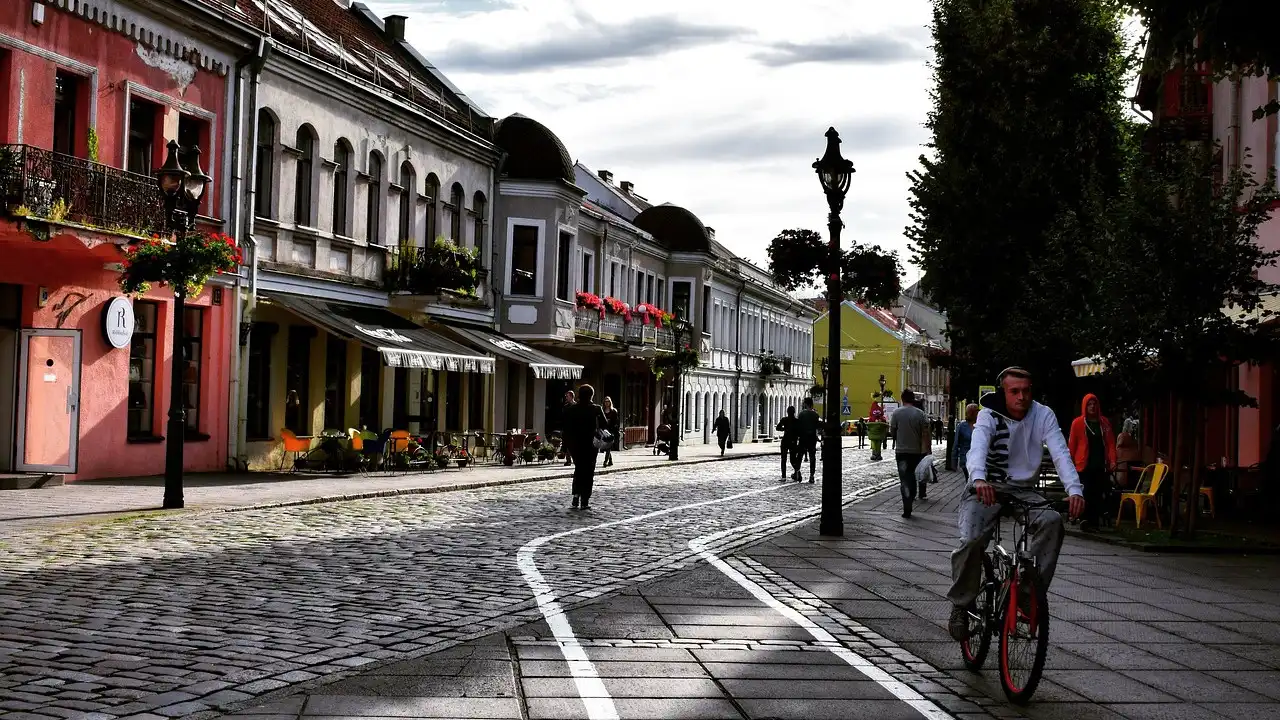
Sveiki! (hello)
If you’re looking at text written in Lithuanian for the first time, you might feel a little intimidated.
You will see familiar letters, but you will also see a lot of “hooks,” dots, and tails attached to them.
Is the Lithuanian alphabet difficult?
Actually, no.
Unlike English, where one letter can have three different sounds (think about the ‘a’ in cat, car, and call), Lithuanian is a very phonetic language.
This means that, for the most part, you read exactly what you see.
Once you learn the sound a letter makes, it almost always makes that same sound.
In this guide, I’ll walk you through the 32 letters of our alphabet, the special “nasal” vowels, and the tricky consonants.
Table Of Contents:
The basics of the alphabet
The Lithuanian alphabet is based on the Latin alphabet (just like English), but we have a few extra letters and we are missing a few.
There are 32 letters in total.
Here is what you need to know immediately:
- We do not use Q, W, or X in standard Lithuanian words. You will only see these in foreign names or borrowed words that haven’t been “Lithuanized” yet.
- We use a specific sorting order. For example, Y comes right after Į, not at the end of the alphabet.
Let’s look at the sounds.
How to pronounce Lithuanian vowels
This is usually the part that confuses beginners the most.
You will see vowels with “tails” on the bottom (like ą) or dots and lines on top (like ė or ū).
In Lithuanian, the length of the vowel is very important.
We generally group vowels into short and long sounds.
Short vowels vs. long vowels
The “tails” under the letters are called nosinės (nasal vowels). Hundreds of years ago, these were pronounced through the nose (like in French).
Today, in standard Lithuanian, the “tail” simply means the vowel is long.
Here is a simple table to help you pronounce them:
| Letter | Short/Long | English Sound Approximation | Lithuanian Example |
|---|---|---|---|
| A a | Short | Like ‘a’ in mama (never like ‘cat’) | Labas (Hello) |
| Ą ą | Long | A longer ‘aaah’ sound (like father) | Ąžuolas (Oak) |
| E e | Short | Like ‘e’ in get | Ne (No) |
| Ę ę | Long | Longer ‘e’ sound (like ‘a’ in bad, but longer) | Katinę (Cat - accusative) |
| Ė ė | Long | Distinct narrow sound. Like ‘ai’ in air (without the ‘r’) | Tėtė (Dad) |
| I i | Short | Like ‘i’ in sit | Ir (And) |
| Į į | Long | Long ‘ee’ sound like in see | Į (In/Into) |
| Y y | Long | Same as Į. Long ‘ee’ like in see. | Yra (Is) |
| O o | Long | Like ‘o’ in law or more (usually always long) | Brolis (Brother) |
| U u | Short | Like ‘u’ in put | Tu (You) |
| Ų ų | Long | Long ‘oo’ sound like in moon | Laukų (Of fields) |
| Ū ū | Long | Same as Ų. Long ‘oo’ like in moon. | Jūra (Sea) |
The special consonants
Most consonants in Lithuanian sound exactly like they do in English (b, d, f, g, k, l, m, n, p, r, s, t, v, z).
However, we have a few distinctive letters with “hacheks” (the little v shape on top). These create a “hushing” sound.
Here are the ones you must memorize:
| Letter | Sound | English Example | Lithuanian Example |
|---|---|---|---|
| Č č | ’ch’ | Like chips | Čia (Here) |
| Š š | ’sh’ | Like shoe | Šaltas (Cold) |
| Ž ž | ’zh’ | Like ‘s’ in vision or pleasure | Žodis (Word) |
| J j | ’y’ | Like ‘y’ in yes (Never like ‘j’ in jump!) | Jis (He) |
| Ch | ’kh’ | Like ‘ch’ in Scottish loch (throat sound) | Chemija (Chemistry) |
Important Note on ‘R’: In Lithuanian, the letter R is rolled (trilled), similar to Spanish or Italian. It is not the soft English ‘R’.
Labas rytas.
Understanding diphthongs
A diphthong is just a fancy word for two vowels stuck together to make one sound.
Lithuanian uses these a lot. You pronounce both letters, but you blend them together smoothly.
Common pairs include:
- ai (like eye or my)
- ei (like hey)
- ui (like oo-ee pushed together quickly)
- au (like ow in cow)
- ie (like ea in ear)
- uo (like wa in water, but starting with an ‘oo’ sound)
Pienas
Duona
The “soft” sign rule
This is a secret tip that helps you sound more like a native speaker.
Often, you will see the letter i coming after a consonant but before another vowel.
In these cases, the i is not really pronounced as a distinct vowel. Instead, it acts as a “soft sign” (similar to Russian). It makes the consonant before it softer.
Let’s look at the most famous Lithuanian word:
Ačiū
It is spelled A-č-i-ū. However, you do not say “Ah-chee-oo”. You say “Ah-choo” (like sneezing!). The i just softens the č sound slightly.
Here is another example:
Lietuva
You don’t pronounce a strong ‘ee’ sound for the i. It blends with the L to make a soft Lie- sound.
Regional pronunciation differences
Lithuania is a small country, but we have very distinct dialects (tarmės).
The main two groups are the Aukštaičiai (Highlanders) and the Žemaičiai (Lowlanders/Samogitians).
Standard Lithuanian is based on the Western Highlanders’ dialect. This is what you learn in books and what you hear on TV.
Žemaičiai (from the West coast), however, speak very differently. To a beginner’s ear, it might sound like a completely different language!
Here are a few fun differences you might hear if you visit the coast (Klaipėda or Palanga):
- They often cut off the endings of words.
- They change the vowel sounds completely. For example, standard duona (bread) becomes douna in Samogitian.
- Standard pienas (milk) becomes pėins.
But don’t worry-almost everyone speaks standard Lithuanian, so you will be understood everywhere you go.
Summary
The Lithuanian alphabet might look hard because of the diacritics (the marks above and below letters), but it’s quite logical.
Remember these key takeaways:
- There are 32 letters.
- Letters with “tails” (ą, ę, į, ų) are long vowels.
- Č, Š, and Ž make “hushing” sounds.
- J is pronounced like ‘Y’.
- If I is before another vowel, it just softens the consonant.
Practice reading out loud, even if you don’t know what the words mean yet. Your mouth needs to get used to the new shapes.